
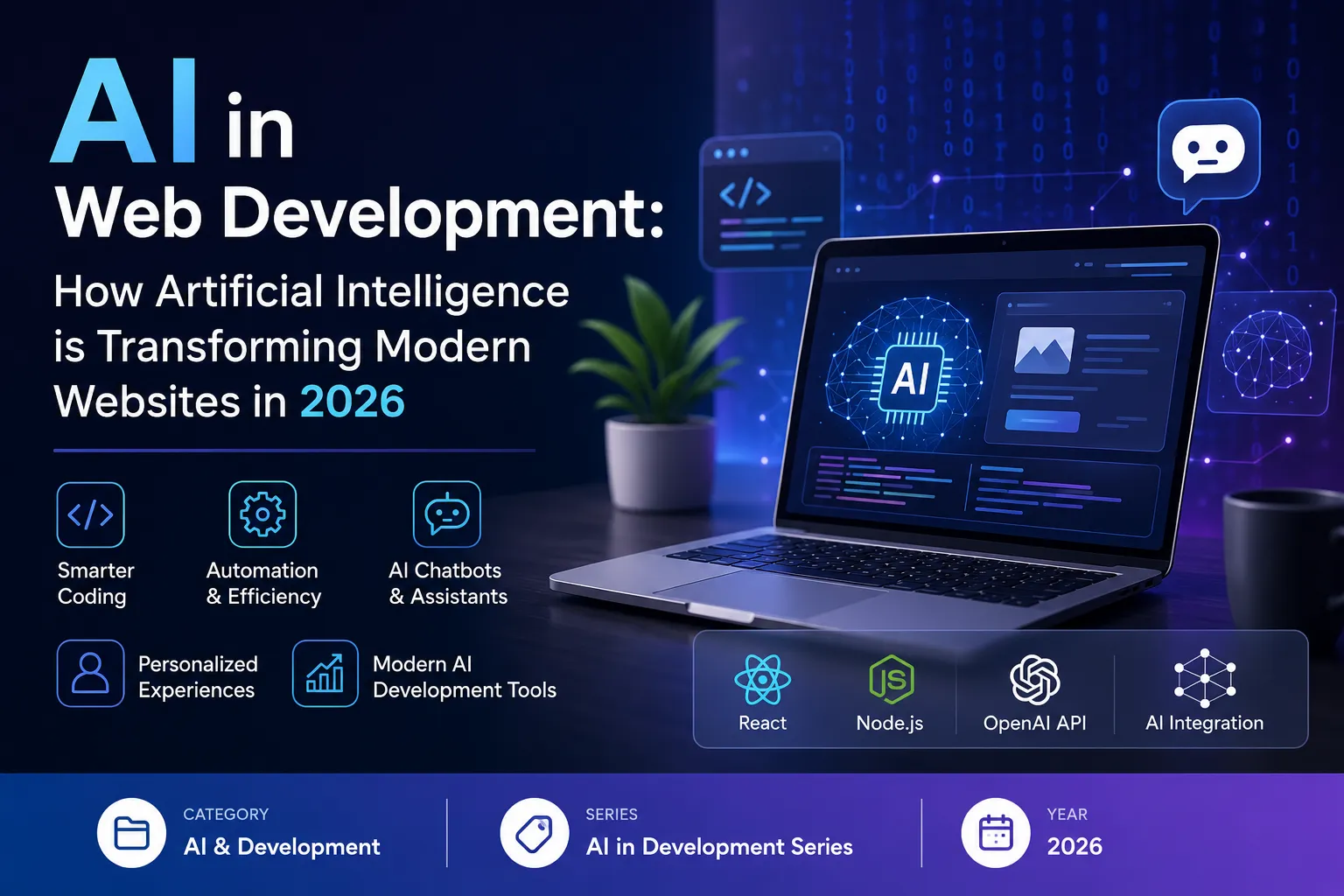
Artificial Intelligence (AI) has evolved from being a futuristic concept to becoming an essential part of modern web development. Whether you’re building a personal portfolio, an eCommerce platform, or an enterprise application, AI is changing how developers write code, optimize performance, enhance user experiences, and automate repetitive tasks.
Developers today are no longer using AI just to generate code snippets. AI assists in debugging, code reviews, UI generation, content creation, testing, personalization, and intelligent automation. Modern AI-powered development environments are helping engineers spend more time solving business problems and less time on repetitive coding tasks.
In this guide, we’ll explore how AI is reshaping web development, the tools making the biggest impact, and practical ways developers can use AI to build faster and better applications.
Why AI Matters in Modern Web Development
Traditional web development often requires significant manual effort across planning, coding, testing, deployment, and maintenance. AI streamlines many of these stages by automating repetitive tasks while providing intelligent suggestions that improve productivity.
Some of the biggest advantages include:
- Faster development cycles
- Improved code quality
- Better user experiences
- Personalized content recommendations
- Smarter search functionality
- Automated customer support
- Enhanced security monitoring
Instead of replacing developers, AI acts as a collaborative assistant that boosts efficiency and allows teams to focus on architecture, business logic, and innovation.
1. AI-Powered Code Generation
Modern AI coding assistants can generate boilerplate code, explain unfamiliar functions, refactor existing code, and even suggest architecture improvements.
Developers working with React, Node.js, Python, or Laravel can dramatically reduce development time by using AI to handle repetitive coding patterns while maintaining full control over implementation.
Benefits
- Generate components quickly
- Reduce syntax errors
- Improve code readability
- Learn unfamiliar frameworks faster
2. Intelligent Website Personalization
AI enables websites to adapt content dynamically based on user behavior, interests, and previous interactions.
Examples include:
- Product recommendations
- Personalized landing pages
- Dynamic pricing strategies
- Smart content suggestions
- Customized email campaigns
These personalized experiences increase engagement and improve conversion rates by making websites more relevant to each visitor.
3. AI Chatbots and Virtual Assistants
AI-powered chatbots have advanced significantly beyond rule-based systems. Modern chatbots understand natural language, answer complex questions, and integrate with business systems to provide meaningful assistance.
Businesses use AI chatbots for:
- Customer support
- Appointment scheduling
- Lead qualification
- Product recommendations
- FAQ automation
This helps improve customer satisfaction while reducing operational costs.
4. Automated Testing and Quality Assurance
Testing is one of the most time-consuming parts of software development. AI assists by identifying bugs, generating test cases, predicting failure points, and improving overall software quality.
Benefits include:
- Faster testing
- Reduced manual effort
- Improved application stability
- Better release confidence
5. AI for UX and UI Design
Design tools now use AI to generate layouts, recommend color palettes, improve accessibility, and create responsive interfaces.
Developers and designers can prototype ideas faster while maintaining consistency across projects.
6. AI-Powered Search
Traditional keyword searches often struggle with natural language queries. AI-powered semantic search understands user intent, delivering more relevant and accurate results.
This is especially valuable for:
- eCommerce websites
- Documentation portals
- SaaS products
- Knowledge bases
7. Enhanced Security
AI strengthens website security by monitoring unusual behavior, detecting suspicious traffic patterns, identifying vulnerabilities, and responding to threats more quickly than manual monitoring.
Applications include:
- Fraud detection
- Login anomaly detection
- Malware monitoring
- Bot prevention
Popular AI Tools for Developers
Some widely used AI tools include:
- GitHub Copilot
- ChatGPT
- Cursor AI
- Claude
- Gemini
- Bolt.new
- Lovable
- Windsurf
Each tool serves different purposes, from code generation and debugging to UI development and documentation.
Best Practices for Using AI in Development
To maximize AI’s value:
- Verify AI-generated code before deployment.
- Keep security and privacy in mind when using third-party AI services.
- Use AI to automate repetitive work, not critical architectural decisions.
- Combine AI assistance with strong software engineering principles.
- Continue learning core programming concepts alongside AI tools.
Future Trends
The next generation of AI development is moving beyond code completion toward intelligent software agents that can plan tasks, coordinate workflows, and assist across the entire development lifecycle. Emerging standards such as Model Context Protocol (MCP) aim to make it easier for AI systems to work with external tools and data sources in a consistent way.
